
How to Check Criminal History in Whitfield County
Begin with the record’s stage. For a filed local matter, use the free Whitfield Court Case Management Web Search. A new booking belongs first with the Whitfield County Sheriff and jail. A Georgia felony-conviction name check uses Georgia Felon Search, while a fingerprint-linked review follows Georgia Crime Information Center instructions. State prison and felony-supervision questions belong with the Georgia Department of Corrections or Department of Community Supervision.
Collect a full name, date of birth when the official system permits it, the event date, and the arresting agency. Search every plausible spelling. Whitfield County’s portal tells users to try name variants, an important step when surnames are compound or recorded in a different order.
- Choose the sheriff, court, GCIC, or corrections source that owns the needed fact.
- Enter the surname before the given name in the county party search, omit suffixes, and use at least two letters.
- Limit by court, division, filing dates, or status only when broad results are too large.
- Compare the case number, filing date, charge, and status with known facts.
- Ask the clerk or creating agency for a certified or complete copy when proof is required.
Whitfield County Portal Search Fields
The direct party-name form exposes a useful set of controls, but it has limits. Inspection found Magistrate Court in the Court Code menu, so a no-result does not clear every Whitfield County court. Superior Court criminal records may require the Clerk’s Criminal Division or a provider reached through Georgia’s E-Access directory.
| Field | Required | How to use it |
|---|---|---|
| Party Name | Yes | Last name, then first name; no suffix; two-letter minimum |
| Court Code | No | Limits the record source |
| Court Division | No | Narrows a selected court |
| Date From / To | No | Sets a filing-date range |
| Case Status | No | Defaults to all statuses |
The official county court interface shows the local entry point in context. The image below comes from the Whitfield court search.
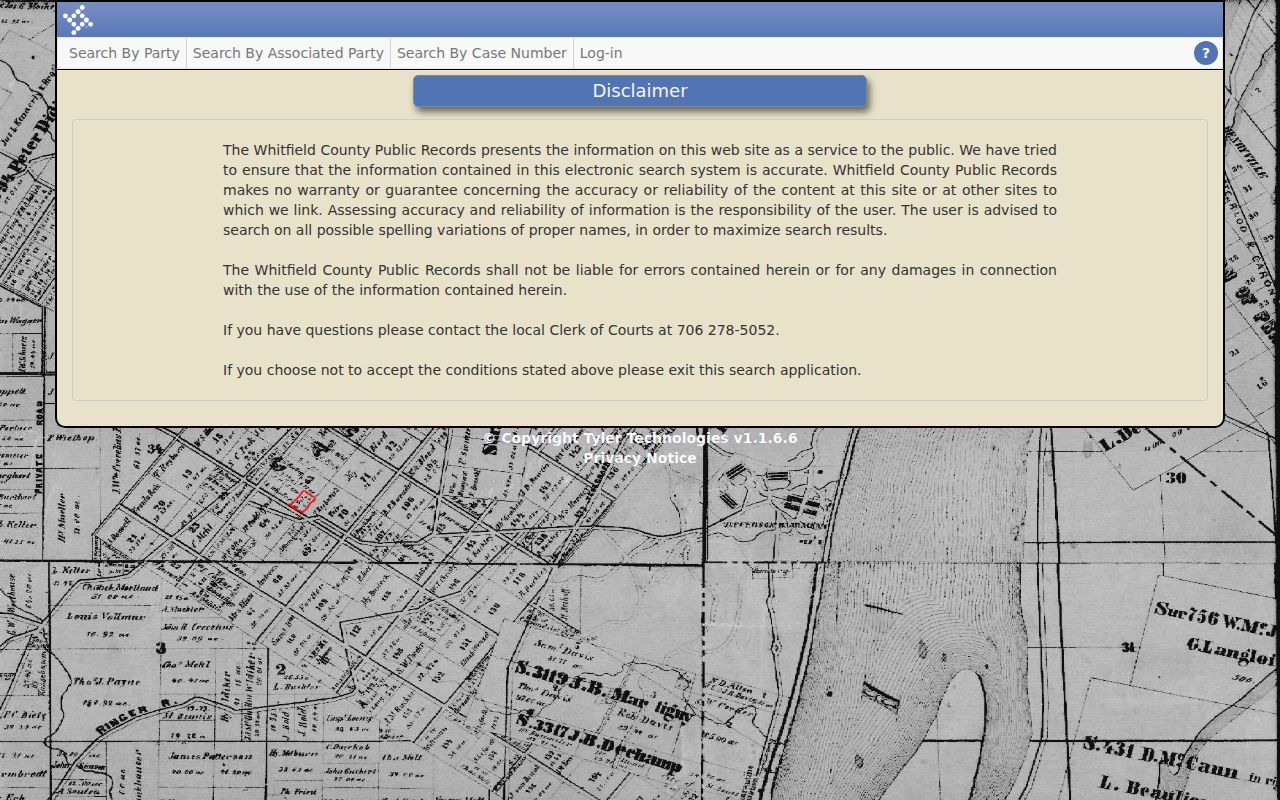
Its disclaimer and spelling guidance explain why the search is a starting point rather than a warranty of a full criminal history.
Official Georgia Background Checks
The Georgia Bureau of Investigation’s Georgia Crime Information Center is the state repository. Georgia Felon Search is its public name-based felony-conviction product. It costs $15 even when no record is returned and excludes misdemeanors, juvenile felonies, and sealed or restricted material. A selected possible-match record costs another $15. It is not a full Whitfield County criminal history.
For a review of one’s own Georgia history, follow GBI criminal-history instructions and the operating rules of a GCIC-authorized local agency. Fingerprints are the sound way to resolve identity disputes. Authorized program checks use Georgia Applicant Processing Service, now administered through IDEMIA/IdentoGO, with the service code supplied by the requesting program. The FBI Identity History Summary is a separate fingerprint-based, subject-only federal check with an $18 FBI fee.
| Product | Scope | Cost or access |
|---|---|---|
| Whitfield case search | Participating local filed cases | Free web search |
| Georgia Felon Search | Possible Georgia felony-conviction matches | $15 search, plus $15 per chosen match |
| GAPS fingerprints | Authorized program result | Program and vendor fee varies |
| FBI summary | Subject’s FBI fingerprint record | $18 FBI fee |
Four Whitfield County Arrest Records
One arrest can create four related records. The arresting agency writes an incident or arrest narrative. Whitfield County Jail creates a booking and custody file. A prosecutor may then file an accusation or seek an indictment, producing a court case. Finally, GCIC may connect a qualifying fingerprinted arrest cycle with the disposition reported by the court or prosecutor.
Each source answers a different question. Booking charges describe intake allegations, not the final charge. A court file shows what was pursued and how it ended. GCIC depends on the contributing agencies and can show an unresolved cycle when a disposition is delayed. The sheriff’s official page is preserved in this county source image.
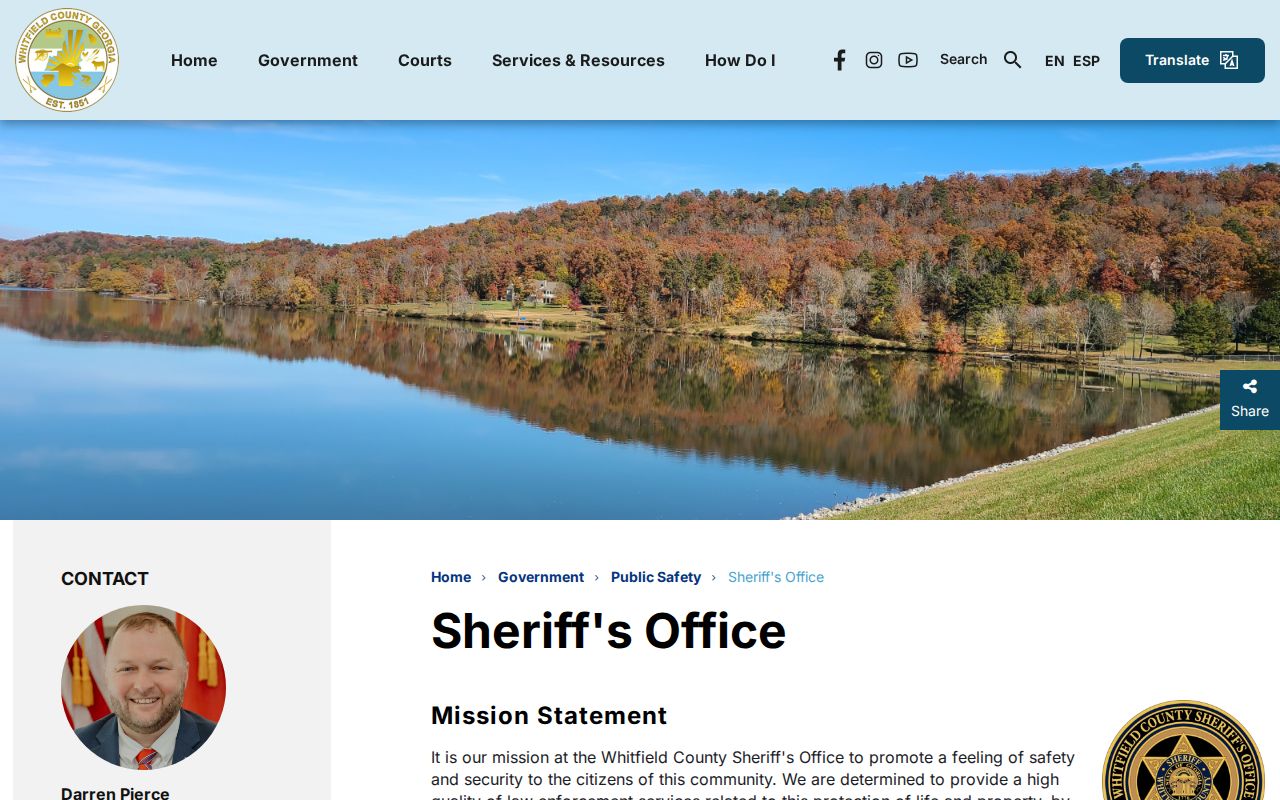
The sheriff channel leads to arrest and jail facts, while final outcomes remain with the proper court.
Types of Criminal Records in Whitfield County
Whitfield County criminal records are divided by the act that created them. An arrest report explains an event and the claimed basis for custody. A booking record logs intake, charge-at-booking, bond, and custody. Charging papers state what the prosecutor actually pursued. The clerk’s file keeps docket events, motions, judgment, sentence, and financial entries. GCIC organizes identification, fingerprint-supported arrest cycles, dispositions, and Georgia custody entries.
- Incident and arrest report: held by the sheriff, Dalton Police, another city police agency, or the specialized agency that wrote it.
- Booking record: held by Whitfield County Jail after intake.
- Court case file: held by the clerk for the venue that heard the charge.
- Warrant record: issued by a court and tracked for service by law enforcement.
- Custody or supervision entry: divided among the county jail, GDC, and DCS.
The county-linked Police to Citizen service supplies inmate, sex-offender, and report-copy routes. Its official interface appears below.
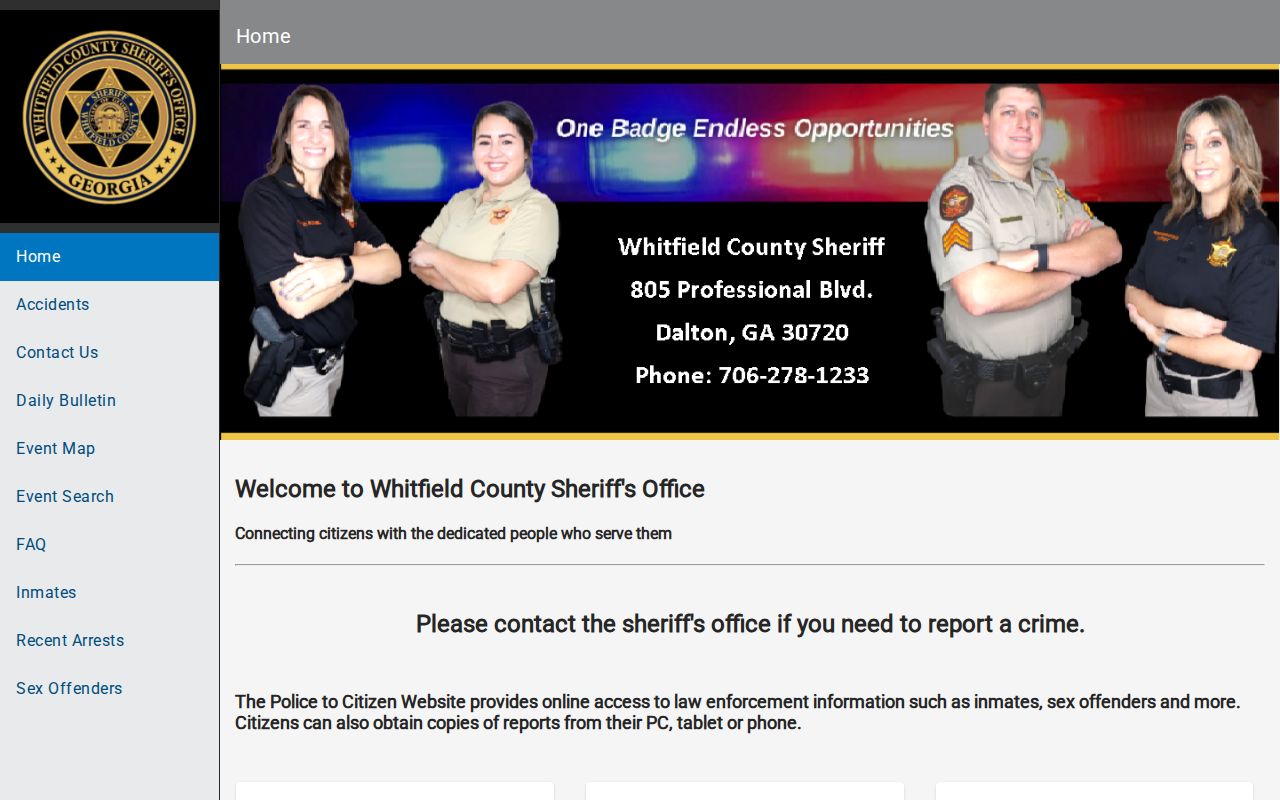
Phone and written-request channels remain important when a portal entry is absent or needs context.
Whitfield Booking and Court Routes
Professional Boulevard is the route for jail and sheriff records. Selvidge Street is the route for filed court records. The Whitfield detention facility has 540 beds and reports an average population near 400, but those figures describe jail operations, not guilt or local crime prevalence. The jail receives people arrested by the sheriff, Dalton, Tunnel Hill, Cohutta, and Varnell police, as well as state and federal agencies.
Central Control can confirm custody and bond information. The clerk handles filed cases and certified outcomes. A person who leaves local jail may later appear in GDC Find an Offender, but that state system does not replace the county roster.
The GDC search interface is documented by this official offender-search source.
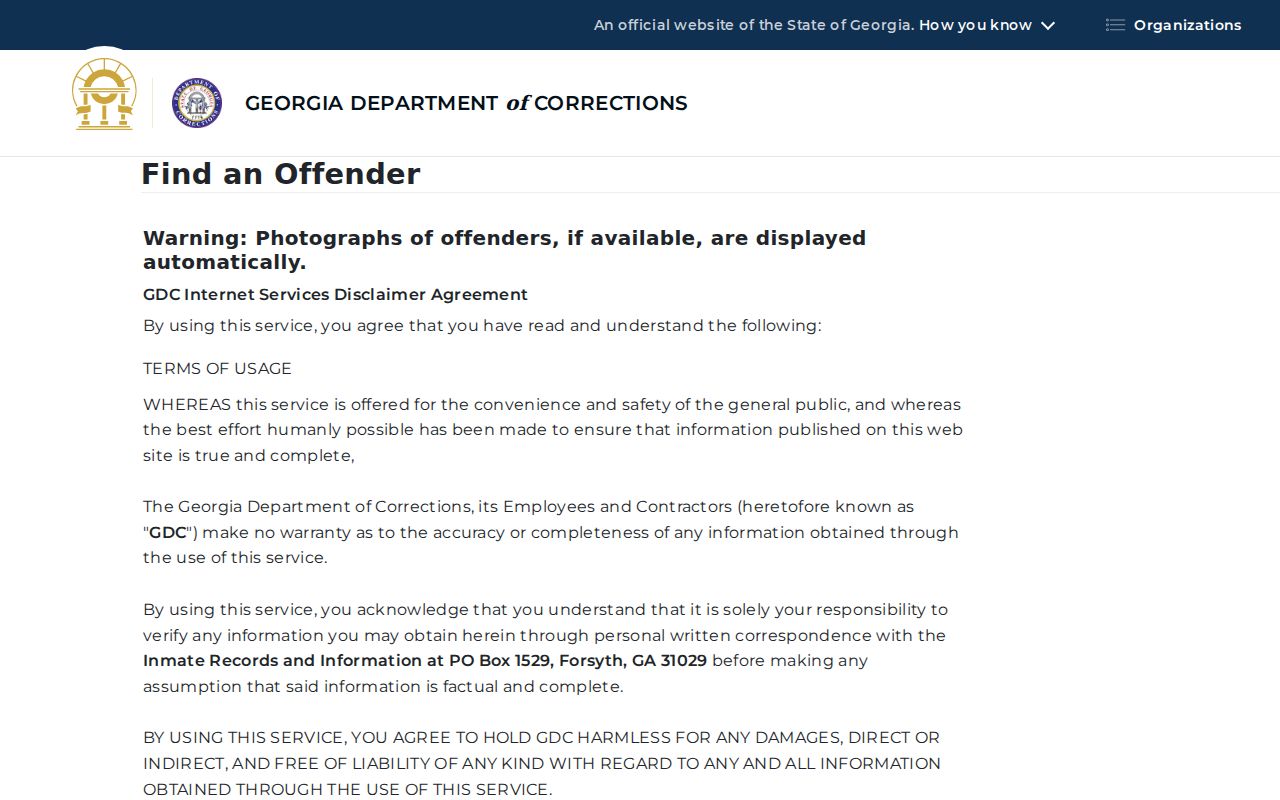
Use it only for state custody or supervision, then return to Whitfield County courts for the filed case and disposition.
What a Whitfield County Criminal Record Shows
The visible fields change with the source. Booking entries focus on custody. Court entries focus on litigation. A GCIC history can include identifiers, arresting agency, arrest date, charges, judicial dispositions, and Georgia correctional data. Public versions should not reveal Social Security numbers, protected victim details, sealed material, or confidential juvenile records.
| Name and identifiers | Names, aliases, date of birth, physical descriptors, and agency identifiers where lawful |
|---|---|
| Arrest and booking | Date, agency, booking identifier, intake charges, bond, and custody status |
| Charges and statutes | Counts alleged at arrest or later filed by accusation, indictment, or complaint |
| Disposition | Dismissal, nolle prosequi, plea, conviction, acquittal, or another reported result |
| Sentence | Confinement, probation, fine, restitution, or other court terms |
| Custody or supervision | County jail, state prison, probation, or parole information when published |
The Clerk of Superior Court is the primary source for felony file and disposition questions.
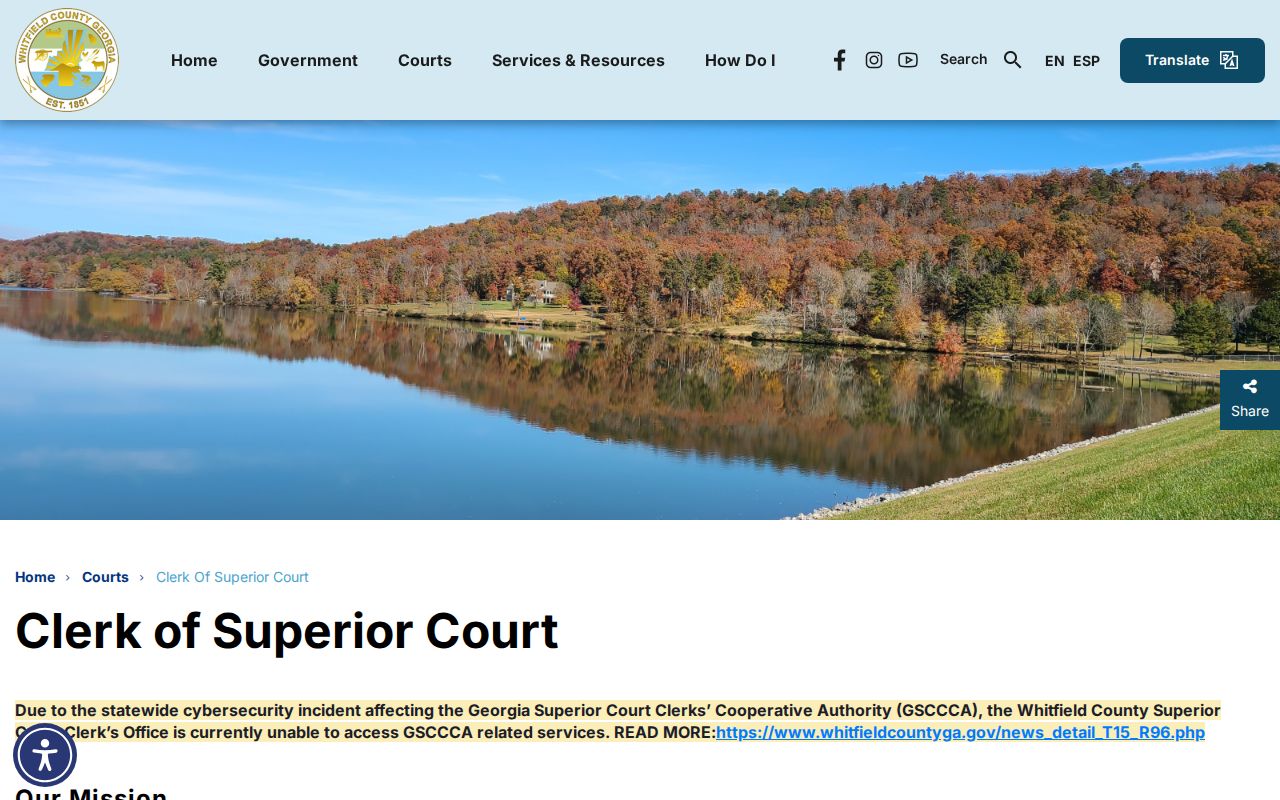
A certified clerk copy carries more weight than a copied portal screen.
Whitfield County Criminal Court Map
Superior Court has exclusive felony trial jurisdiction in the Conasauga Judicial Circuit, which joins Whitfield and Murray counties. State Court handles misdemeanors and traffic matters within its jurisdiction. Magistrate Court handles warrants, first appearances, and preliminary matters. Probate Court handles most assigned county traffic cases. Municipal courts keep city ordinance and qualifying misdemeanor or traffic matters.
Clerk Criminal Division
205 N Selvidge St
Dalton, GA 30720
706-275-7490
Whitfield Magistrate Court
County courthouse
706-278-5058
Whitfield Sheriff
805 Professional Blvd
Dalton, GA 30720
706-278-1233
The official Conasauga Circuit court page is shown below.
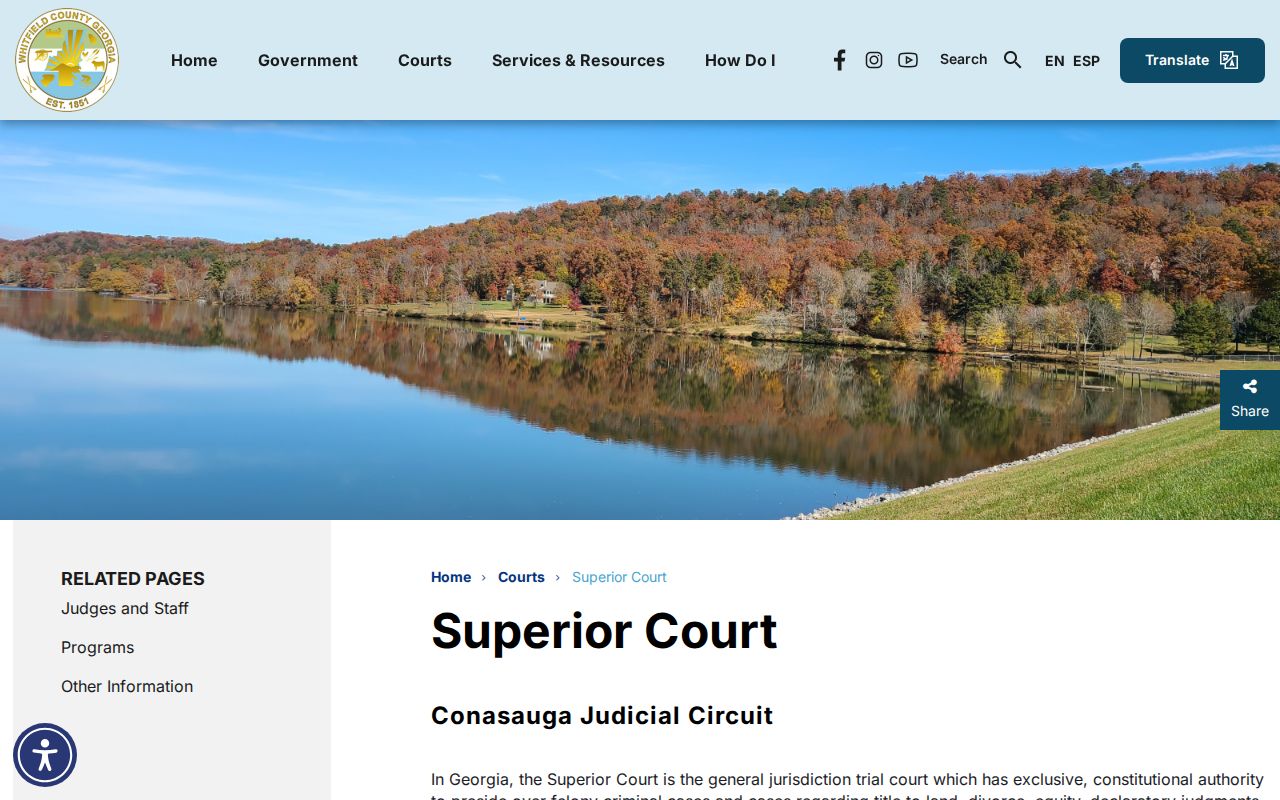
Its circuit structure explains why a Dalton-area reference alone does not prove the filing is in Whitfield County.
The county also publishes judge and staff information.
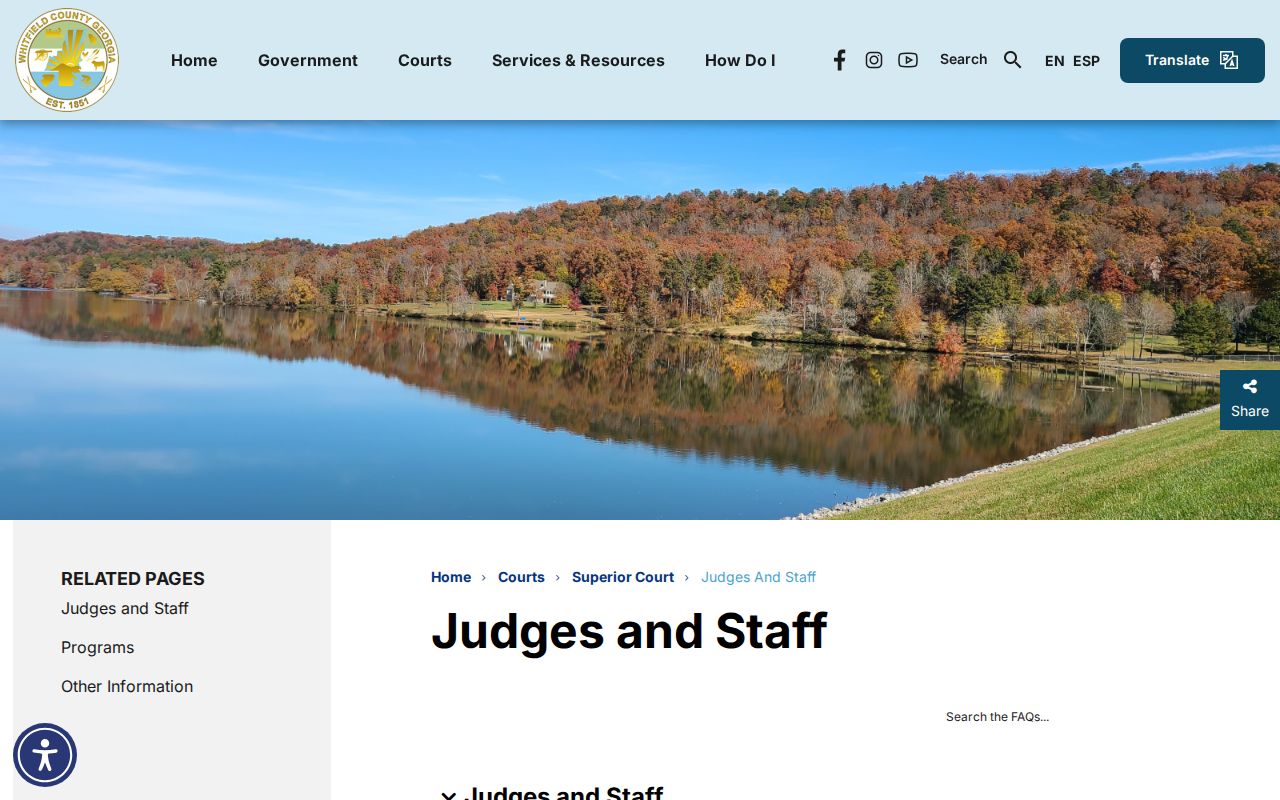
Staff can route a file request, but they cannot give legal advice or prepare a filing.
Public Access Laws for Whitfield County Criminal Records
The Georgia Open Records Act presumes agency records open unless an exemption applies. The custodian generally has three business days to produce an available record or explain when production will occur and the legal basis for withholding. Ask for an existing record, not a custom report. Active investigations, juvenile matters, confidential victim information, medical data, security details, and personal identifiers may be withheld or redacted.
Key Georgia authorities:
O.C.G.A. §50-18-70 et seq. presumes public access to agency records, subject to exemptions.
O.C.G.A. §35-3-35 governs GCIC criminal-history dissemination.
O.C.G.A. §35-3-37 governs record restriction, correction, and related court sealing.
Uniform Superior Court Rule 21 leaves courtroom recording and electronics under judicial control.
The state-hosted open-government citizen guide gives added context for requests. Send a narrow request to the agency that created or keeps the specific record.
Whitfield County Warrant Check Chain
Georgia has no public statewide warrant search, and no verified Whitfield County active-warrant portal or law-enforcement app was found. Call the sheriff at 706-278-1233, then the issuing court. Magistrate Court can address its matters at 706-278-5058. A Dalton or Varnell bench warrant may require the municipal court instead. An in-person warrant inquiry can lead to immediate custody.
Do not trust a text that demands money to stop a bench warrant. The Whitfield clerk warns that neither the Clerk nor Sheriff texts a demand for $500 or asks for banking data in that way. Verify the case number and bond terms through official numbers, arrange any appearance or surrender lawfully, and obtain written proof when a warrant is recalled or satisfied.
The Magistrate Court source provides the local court context.
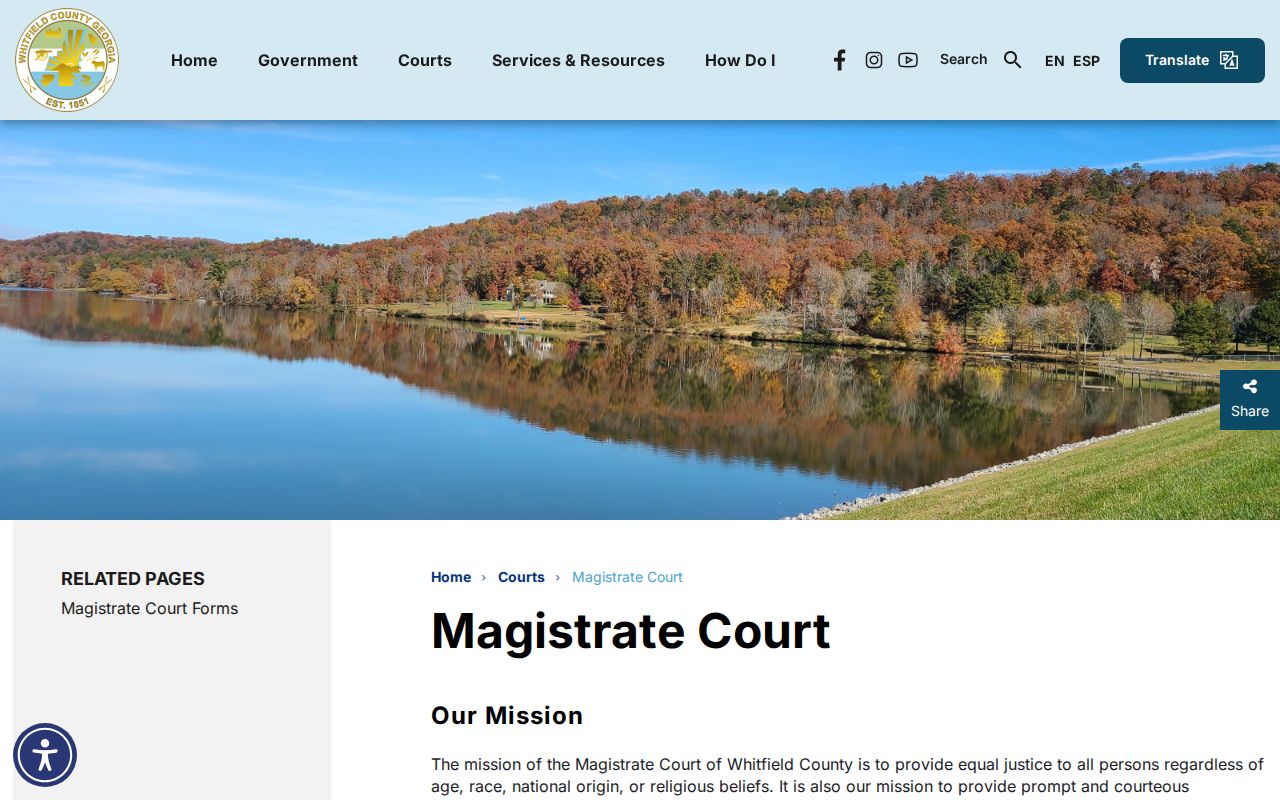
Sealed warrants and juvenile matters will not appear in an ordinary public search.
Sealed, Expunged, and Restricted Records
Georgia’s statutory term is record restriction. Restriction limits dissemination of eligible GCIC arrest information, while sealing addresses public access to eligible court records. Neither process means every agency document was destroyed. Eligibility depends on the arrest date, outcome, charge, and later history, with separate treatment for First Offender and juvenile matters.
For a Whitfield County record, obtain the arrest cycle and certified final disposition. Identify the arresting agency, prosecutor, and court. Follow GCIC instructions for the correct arrest era, file any needed motion in the court that handled the case, and request sealing when the law allows. After an order, recheck both the court portal and one’s GCIC history. If an outcome is still missing, take the signed order and certified disposition to the clerk, contributing agency, and GBI correction channel.
Whitfield County Specialty Court Records
Whitfield and Murray share several local accountability programs. Drug Treatment Court is an 18 to 24 month path for eligible nonviolent drug-related cases, with treatment, testing, review hearings, and phased progress. Mental Health Court began in 2018 and uses voluntary referrals, prosecutor review, screening, and team admission. Domestic Violence Court grew from a 2014 local assessment and uses the RESOLV intervention program, though the county notes it is not an officially recognized Council of Accountability Court Judges program.
Participation does not erase the need to read the file. The docket and final order show how the case was resolved. Program offices are at 301 W Crawford Street in Dalton, with a published line of 706-281-4811. Protected treatment details do not become an open public file merely because hearings or outcomes appear on a docket.
Whitfield County’s official government directory connects these court and service offices.
The directory is the best place to confirm current counter hours before travel.
Whitfield County Traffic Record Limits
A criminal-history search can miss traffic and ordinance matters because court jurisdiction is split. Whitfield Probate Court handles most assigned county traffic matters. Dalton, Varnell, and Tunnel Hill municipal channels handle their own qualifying matters. The county portal’s inspected court selection does not establish that all those records are indexed together.
The official Probate Court traffic page appears below.
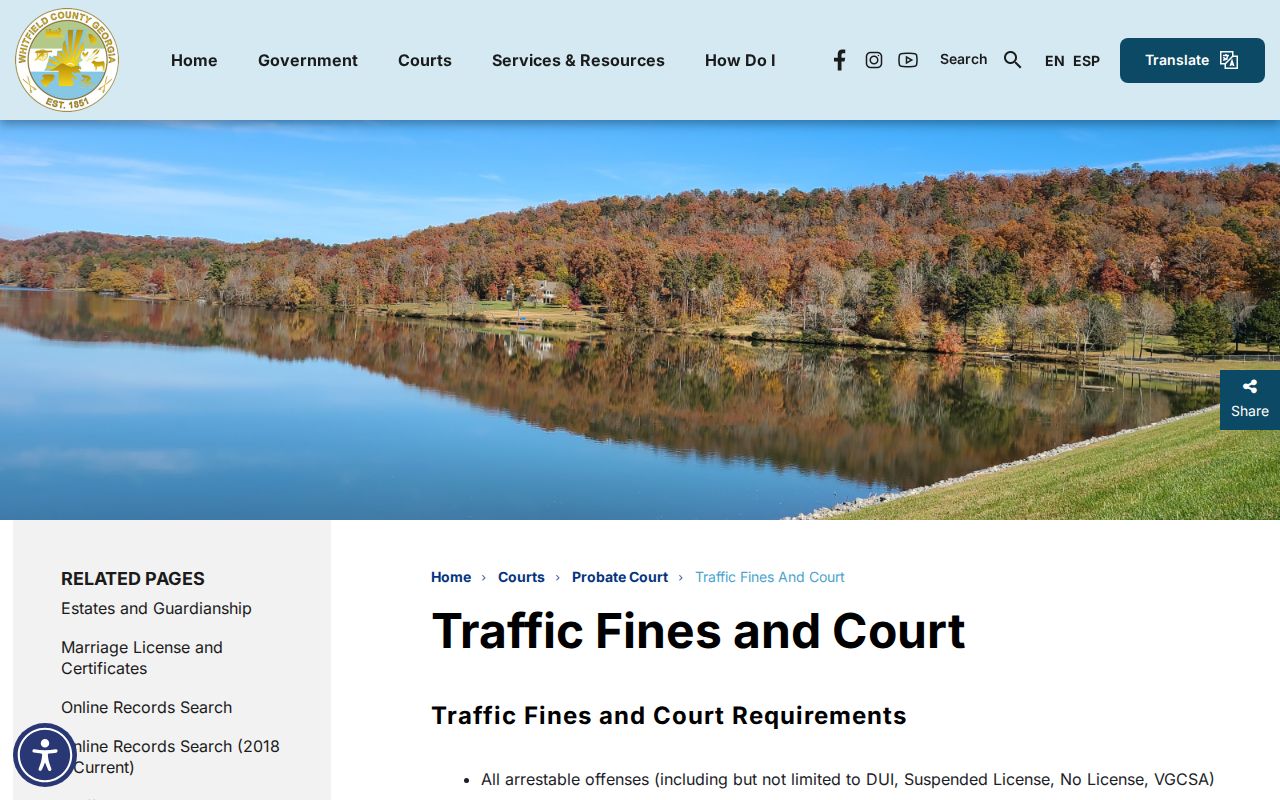
Use the issuing agency and exact event location to choose the right court rather than assuming every Dalton-area citation is a Superior Court file.
Whitfield County Record Terms
Short docket labels can change the meaning of a result. Read the event line and disposition before treating any charge as final.
- Accusation
- A prosecutor-filed charging instrument used in eligible Georgia cases.
- Indictment
- A grand-jury charging instrument, commonly used for felonies.
- Nolle prosequi
- The prosecutor’s formal choice not to pursue a charge at that time.
- Disposition
- The result of a charge or case, not a synonym for conviction.
- OTN
- An 11-digit tracking number created after required fingerprints transmit successfully to GCIC.
- Record restriction
- Georgia’s limit on dissemination of an eligible criminal-history entry.
Whitfield’s court data can be complete even when a state history still lacks the result. Courts send dispositions through the Georgia Court Data Exchange, and its dashboard refresh cycle can expose submission or error lag. Correct the source record first, then ask GCIC to update the linked arrest cycle.
Criminal Records by City in Whitfield County
City boundaries decide which police agency owns an incident report and which municipal court may hold a citation. Dalton, Varnell, and Tunnel Hill are Whitfield County’s three largest incorporated places in the research ranking. City records can move to the county jail and county courts, but the first report remains with the creating city agency.
Dalton Criminal History
34,417 residents in 2020; city police records and a separate Municipal Court channel.
Varnell Criminal History
2,049 residents in 2020; City Hall, police, and municipal court routes.
Tunnel Hill Criminal History
963 residents in 2020; verify whether the event was on the Whitfield side.